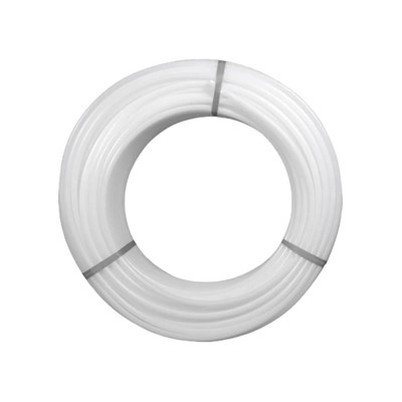
How does the size of PERT tubing affect the flow rate?
Leave a message

Hey there! I'm a supplier of PERT tubing, and today I wanna talk about how the size of PERT tubing affects the flow rate. It's a topic that's super important for anyone dealing with plumbing systems, whether you're a professional plumber or just a DIY enthusiast.
First off, let's quickly understand what PERT tubing is. PERT, or Polyethylene Raised Temperature, is a type of plastic tubing that's widely used in heating and plumbing systems. It's known for its flexibility, durability, and resistance to high temperatures. You can learn more about it here: PERT Tube.
Now, let's dive into the main topic - the relationship between the size of PERT tubing and the flow rate. Flow rate, in simple terms, is the amount of fluid (like water or coolant) that passes through a pipe in a given amount of time. It's usually measured in gallons per minute (GPM) or liters per second (L/s).
The size of PERT tubing is typically defined by its outer diameter (OD) and wall thickness. Common sizes range from 1/4 inch to 2 inches in OD. The inner diameter (ID), which is the actual space through which the fluid flows, is what really matters when it comes to flow rate. As the ID of the tubing increases, the flow rate generally increases too.
Think of it like a highway. A two - lane highway can only handle a certain number of cars at a time. But if you widen it to a four - lane highway, more cars can pass through in the same amount of time. Similarly, a larger - diameter PERT tube provides more space for the fluid to flow, allowing a greater volume of fluid to pass through per unit of time.


Let's look at some scientific principles to understand this better. According to the Hagen - Poiseuille's law, the volumetric flow rate (Q) of a viscous fluid through a cylindrical pipe is given by the formula:
[Q=\frac{\pi R^{4}\Delta P}{8\mu L}]
where (R) is the radius of the pipe (half of the inner diameter), (\Delta P) is the pressure difference across the ends of the pipe, (\mu) is the dynamic viscosity of the fluid, and (L) is the length of the pipe.
From this formula, we can see that the flow rate is proportional to the fourth power of the radius. This means that even a small increase in the radius (or inner diameter) of the PERT tubing can lead to a significant increase in the flow rate. For example, if you double the radius of the tube, the flow rate will increase by a factor of (2^{4}=16)!
However, it's not all about just increasing the size of the tubing. There are some practical considerations. Larger - diameter PERT tubing is more expensive than smaller - diameter ones. It also takes up more space, which can be a problem in tight plumbing installations.
Another factor to consider is the pressure in the system. In a plumbing system, the pressure is generated by a pump or the water supply. If the pressure is low, increasing the size of the tubing might not result in a significant increase in the flow rate. This is because the fluid doesn't have enough "push" to take advantage of the extra space in the larger tube.
On the other hand, if the pressure is too high, using a smaller - diameter tube can cause problems. The high pressure can lead to increased friction within the tube, which can result in noise, vibration, and even damage to the tubing over time.
Let's take a look at some real - world scenarios. In a small residential heating system, a 1/2 - inch PERT tube might be sufficient to provide an adequate flow rate of hot water to the radiators. But in a large commercial building with multiple floors and a high demand for water, 1 - inch or even 2 - inch PERT tubing might be required.
When choosing the right size of PERT tubing for a project, you also need to consider the type of fluid being transported. Different fluids have different viscosities. For example, water has a relatively low viscosity, while some types of coolant or oil can be more viscous. A more viscous fluid will flow more slowly through a tube of the same size compared to water. So, for a viscous fluid, you might need a larger - diameter tube to achieve the desired flow rate.
In addition to the inner diameter, the length of the PERT tubing also affects the flow rate. The longer the tube, the more resistance the fluid will encounter as it flows through. This is because the fluid has to overcome more friction along the walls of the tube. So, if you have a long run of PERT tubing, you might need to increase the diameter to maintain an acceptable flow rate.
Now, you might be wondering how to calculate the right size of PERT tubing for your specific project. There are some online calculators available that can help you with this. These calculators take into account factors such as the flow rate you need, the pressure in the system, the length of the tube, and the type of fluid.
As a PERT tubing supplier, I've seen many customers struggle with choosing the right size of tubing. That's why I'm here to help. Whether you're working on a small home improvement project or a large - scale commercial installation, I can provide you with the right advice and the high - quality PERT tubing you need.
If you're interested in purchasing PERT tubing or have any questions about sizing, flow rates, or anything related to PERT tubing, don't hesitate to get in touch. We can have a detailed discussion about your project requirements and find the best solution for you.
In conclusion, the size of PERT tubing has a significant impact on the flow rate. By understanding the scientific principles and considering the practical factors, you can choose the right size of tubing for your plumbing or heating system. So, whether you're looking to upgrade your home's plumbing or start a new commercial project, make sure you give proper thought to the size of the PERT tubing you use.
References
- Incropera, F. P., & DeWitt, D. P. (2002). Fundamentals of Heat and Mass Transfer. John Wiley & Sons.
- White, F. M. (2006). Fluid Mechanics. McGraw - Hill.